

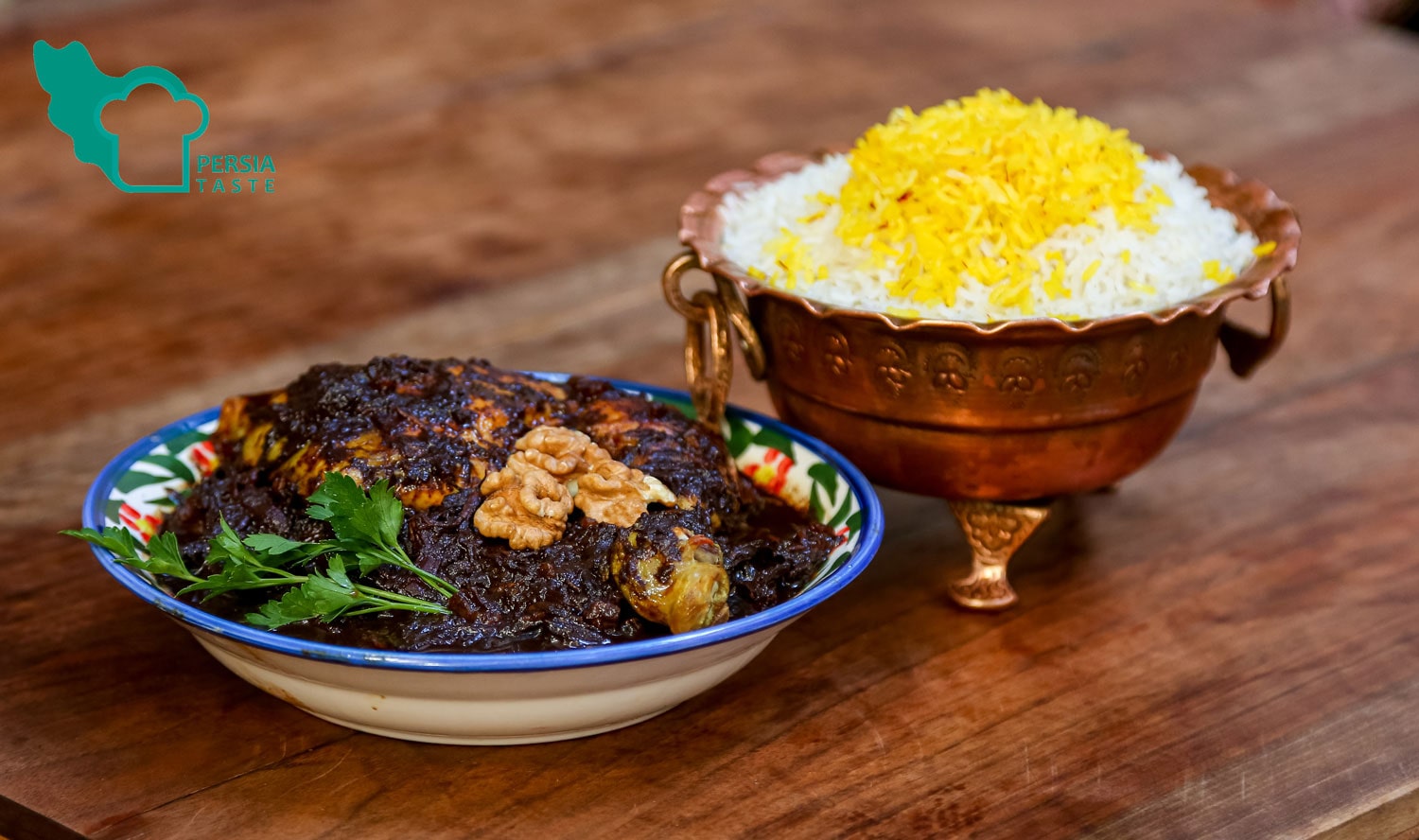
Fesenjoon (or Fesenjan): A FOOD FOR WALNLUT LOVERSReading Time: 5 min
BACKGROUND
If you are a fan of walnuts, like me, then this Iranian food is the best option for you, to quench your desire. Coming originally from the North part of Iran, the popularity of this food is not restricted to just the north, almost in all parts of the country you can find a local version of Fesenjoon. The food is made on different occasions, however, in north provinces specifically Guilan, having it as an inseparable part of wedding celebrations is a must.
Besides walnut, another unavoidable ingredient employed in Fesenjoon is pomegranate. Being known as Iran’s national fruit, using pomegranate in the food, indicates the significance of this stew among Iranians. Anaar (as the pomegranate is called in Persian), bears both cultural and religious significance for Iranians; both Persian poetry and art are filled with the presence of this fruit. It’s a common belief that Anaar is a fruit of heaven and reflects fertility.
Throughout the country varieties of Anaar can be found, with distinct tastes and colors. Making use of each type of these pomegranate creates different tastes in Fesenjoon. Generally, it can be said that, in the North part of the country, Fesenjoon is mostly sour, while in Tehran, it has a sour-sweet taste, and in cities such as Kerman and other central provinces people are inclined to have it sweet. Even in a small province like Guilan, one can find various recipes of Fesenjoon or as it is called in the local language “Aghuz Ghatogh”. For example in Rudbar, the food has a light brown-green color, in Astaneh Ashrafiye the color is almost red as they use tomato paste alongside pomegranate paste, and in Amlash you can find it dark brown.
WHAT DO YOU NEED TO MAKE Fesenjoon?
Let’s get familiar with some of the chief factors in the process of preparing this food in the north, since in this article I’m going to focus mostly on Guilan’s version of Fesenjoon, and give my recipe.
To have it as traditional as possible we need:
Gamaj: the special pot used in Guilan province
Walnut: people make sure to buy the local ones since they have better taste and produce more natural oil while cooking
Duck meat: it’s common to use other types of meat but if you want to have it like the local people then using duck is a proper option
Sour pomegranate paste: in the Northern provinces, people make their pomegranate paste or buy it from local markets in which the country women sell homemade ones.
Wild plum paste: originally it is provided from local markets which are quite common in every city of Guilan province
Nimkar (Namak yar): a traditional clay utensil used to grind walnut with the help of a unique stone called Moshte Sang.
Nowadays, not as common as it used to be, however, in small villages it is still people’s top choice to prepare walnut or other traditional things like Dalar(in local language) or Namak Sabz (in the Persian language).
Ingredients
Here I’m going to give my family’s recipe, one that my aunt taught me:
Ground walnuts: 1 cup
Duck meat: 300 gr (either chicken or red meat is acceptable too, in some parts of the country using meatballs are more popular)
Sour Pomegranate paste: ½ teaspoon (the exact amount depends on the sourness of the paste)
Plum paste: ½ teaspoon (usually sour or sour-sweet)
Tomato paste: ¼ teaspoon
Onion: 3 small-sized
Salt: to taste
Black pepper: a pinch
Turmeric: a pinch
Water: as much as necessary (usually 3-4 cups)
Ice cubes (small ones): 5-6
Attention: in this version of Fesenjoon we do not use any oil. The food relies heavily on walnut’s natural oil
To make the food we need 2 separate pots; one for cooking duck and the other one Gamaj or any other pot
Reciepe
Step 1:
First of all, pour one cup of water into a bowl and add ground walnut, mix them with your hands until the walnut is completely mixed with water. Then place a fine-mesh strainer over a bowl to strain the mixture of walnut and water (This will make our Fesenjoon has a smoother texture), pour it into the Gamaj.
Step 2:
Put duck meat in a pot, add water, and cut 2 onions into wedges. Put it over the heat and let it boil for 15 minutes. Then drain it and add the meat to the Gamaj. Pour 4 cups of water into the pot.
Step3:
Grind the last onion, Remove its water and add it to the mixture.
Step4:
Now, add turmeric, salt, and pepper. Put the Gamaj over the low heat. After about half a minute add pomegranate, plum, and tomato paste, and let it cook for approximately 5 hours. Meanwhile, you need to check it, and when the stew is getting thickened add one or two ice cubes each time. Repeat it 3-4 times during the food preparation. This method act as a way to extract walnuts’ oil more and more. In the end, you’ll have a stew with at least 2-3 centimeters of oil on top of it. In Guilan people usually let the stew cook slowly overnight.
Now you have a delicious persian meal. But be careful not to gain too much weight! Fesenjoon is a very nutritous and strong food.
Summary
Coming from the north part of the country, this food has found its way into every Iranians’ house. Almost everybody loves it and the reason lies in the fact that Fesenjan is made in different tastes, ranging from sweet to sour and sweet-sour. For those walnut lovers out there the food is a must.